POS System vs Manual Register in Pakistan: 7 Things That Change When You Switch
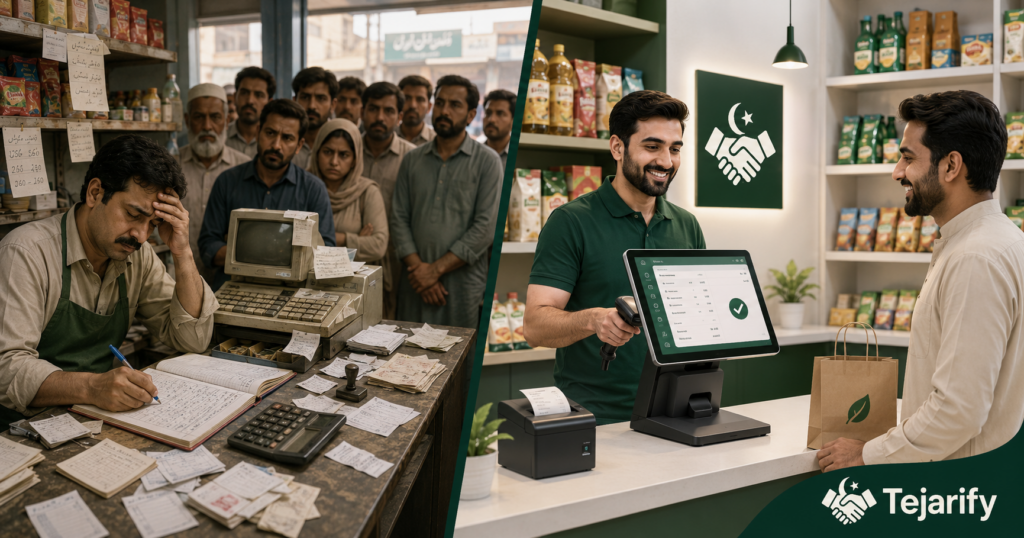
Written by the Tejarify Product Team – based on data from 500+ retail and wholesale businesses across Pakistan.
Summary: Most retail shops in Pakistan still rely on paper registers and handwritten khata books. This guide breaks down exactly what changes when you switch to a POS system, with real numbers and real scenarios from the Pakistani market.
Quick Answer
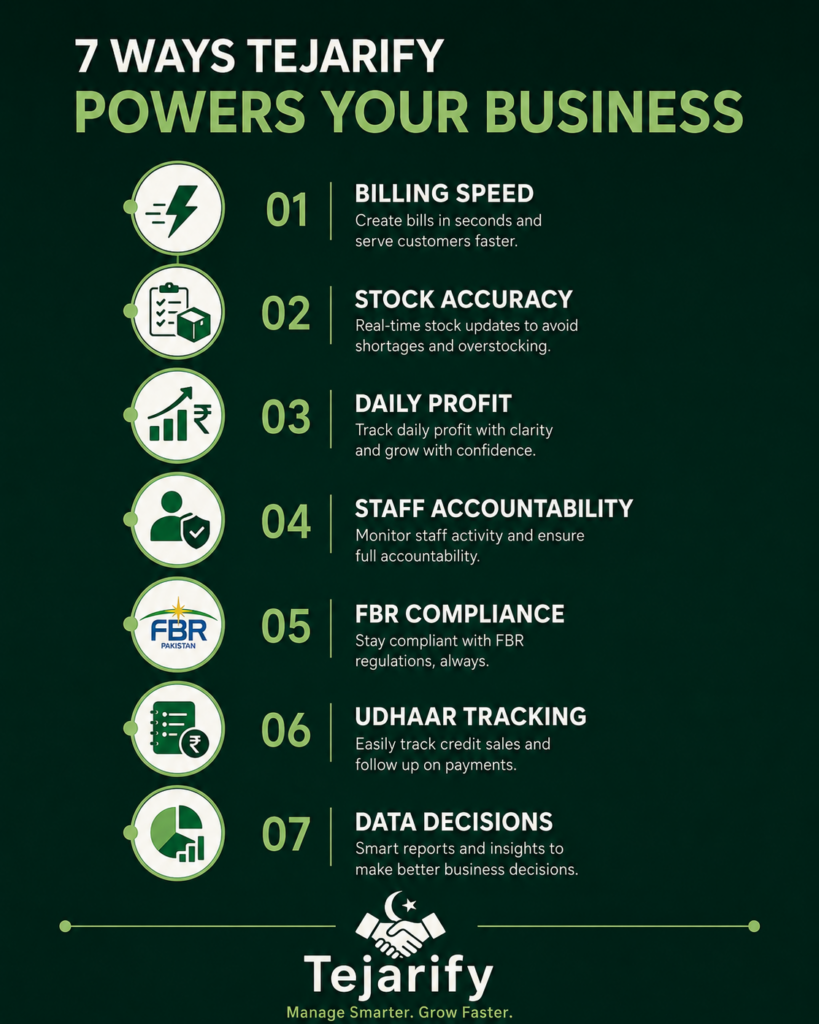
A POS system replaces your manual register, khata book, and stock count with one connected digital system. When you switch, 7 things change immediately: billing speed, stock accuracy, financial visibility, staff accountability, FBR compliance, customer credit tracking, and data-driven decisions. For most retail shops in Pakistan doing more than 50 transactions a day, the switch pays for itself within 3 months.
1. Billing Speed Goes From 3 Minutes to 30 Seconds
In a typical kiryana or general store in Karachi or Lahore, a manual transaction takes 2 to 4 minutes. The cashier writes items, calculates by hand, makes change, and writes the receipt. Errors happen. Queues form.
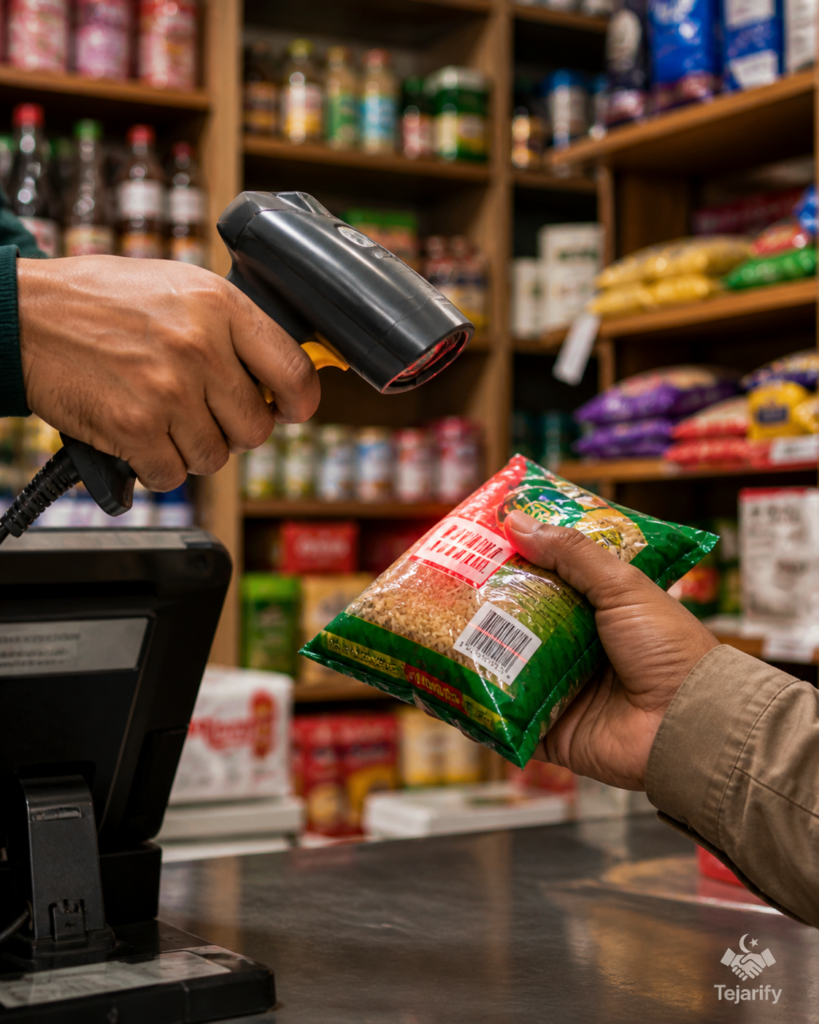
With a POS system and a barcode scanner, the same transaction takes under 30 seconds. A shop doing 100 transactions a day saves 3 to 4 hours of cashier time. Peak hours like Eid, Ramadan, and weekend evenings become manageable instead of chaotic.
2. Your Stock Count Becomes Accurate in Real Time
With a manual system, stock is counted weekly or monthly. It is almost always wrong by the time you check it. A common scenario in Pakistani retail: your register shows 100 units but the shelf only has 73.
A POS system deducts stock automatically with every sale. It tracks every movement. When stock drops below a threshold you set, it sends you a low-stock alert so you never run out of a fast-selling item.
3. You Know Your Daily Profit Without Any Calculations
Ask any shop owner in Pakistan how much profit they made last month. Most will guess. A POS system connected to inventory calculates gross profit automatically. The Roznamcha report shows you exactly where you stand at the end of every day – no manual calculations needed.
4. Staff Accountability Becomes Automatic
Unauthorized discounts, unrecorded sales, and cash shortfalls are common in manual environments across Karachi, Lahore, and Faisalabad. A POS system requires staff to log in with a PIN before processing any transaction. Every sale is recorded against their name. Every discount requires manager approval.
5. FBR Compliance Becomes Built-In, Not a Headache
Since 2020, the FBR in Pakistan has been rolling out its POS Integration program for Tier-1 retailers. If your shop meets the annual turnover threshold, you are legally required to use an FBR-integrated POS system.
Tejarify automatically generates GST invoices with all correct fields including NTN, STRN, item descriptions, tax breakdowns, and QR codes. Your receipts are audit-ready from day one.
6. Customer Credit Tracking Goes Digital
Udhaar is deeply embedded in buying and selling culture across Pakistan. The problem is not udhaar itself – it is tracking it. A paper khata book gets lost, damaged, or disputed.
A POS system with a built-in digital ledger gives every customer an account. Every credit transaction is recorded. You can set credit limits and block new sales automatically when a customer exceeds their limit.
7. Business Decisions Are Driven by Data, Not Guesswork
Manual systems force you to manage on memory and intuition. A POS system replaces every guess with data. With Tejarify’s Munshi AI, you can ask your business data questions in plain English or Urdu – which product made the most profit this month? The system answers instantly.
Is Your Shop Ready to Switch?
Consider switching to a POS system if any of the following apply:
- You process more than 30 transactions per day
- You carry more than 50 different products
- You extend credit to customers and track it manually
- You have more than one staff member handling cash
- You have experienced stock discrepancies or cash shortfalls
- Your annual turnover places you in the FBR Tier-1 category
- You want to expand to a second branch or add an online store
Frequently Asked Questions
How much does a POS system cost in Pakistan?
Cloud-based solutions like Tejarify operate on a monthly subscription, making them accessible without a large upfront investment. Hardware including a barcode scanner and receipt printer typically costs between Rs. 15,000 and Rs. 40,000 as a one-time setup.
Do I need internet to run a POS system in Pakistan?
Modern POS systems work in low-connectivity environments. Core functions like billing and stock deduction work offline. Data syncs automatically when connectivity is restored.
Is a POS system mandatory for all shops in Pakistan?
Not all shops are required to use an FBR-integrated POS. The requirement applies to Tier-1 retailers as defined by the FBR based on location, business type, and turnover.
What is the difference between a POS system and an ERP for Pakistani businesses?
A POS handles the transaction layer: billing, receipts, and cash management. An ERP adds inventory, accounts, purchasing, and reporting. Tejarify combines both so you get the full picture without two separate systems.
Start Running Your Business on a Smarter System
Tejarify is Pakistan’s most complete retail and wholesale management platform. POS billing, real-time inventory, digital udhaar ledger, FBR-compliant invoicing, ecommerce storefront, salesman tracking, and Munshi AI – all in one place.
Built for Pakistan. Built for growth.
Visit tejarify.com to learn more and get started.
Tejarify is a B2B SaaS platform built for retail and wholesale businesses in Pakistan. Visit tejarify.com to explore all features.