1. Offline software does not scale
The shop PC worked for one counter. It fails the moment you open the second.
Desktop software, a local server, a USB backup: tools for one shop pretending to be a company system. The next city cannot log in. When the machine dies, the branch dies with it.
What it costs you: You delay opening locations, or you clone the same broken install ten times.
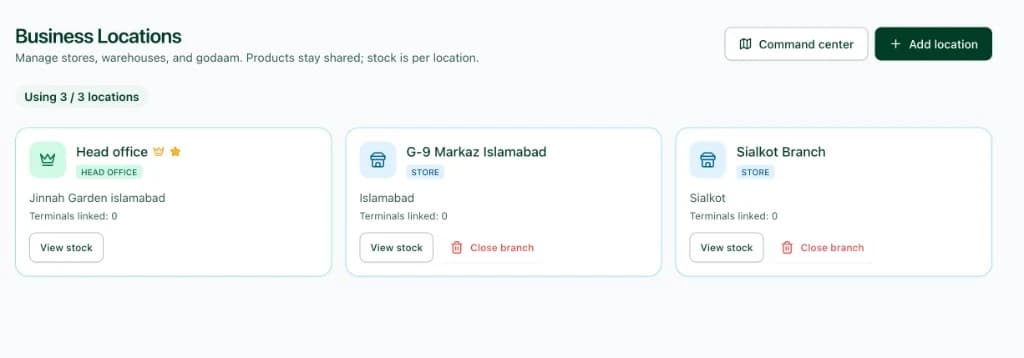
With Tejarify: Add a branch and it is on the network the same day: stock, POS, and staff. No new install visit.
2. Ten people in ten branches matching books
You are not growing operations. You are growing a reconciliation department.
Each branch closes its own day. Someone types it into head-office Excel. Month-end is a week of matching, not a week of selling.
What it costs you: Salary for people whose job is to make ten notebooks look like one company.
With Tejarify: Books match because they are the same books. Head office sees every branch without a night shift of data entry.
3. Ten systems taped into one
POS here. Inventory there. Accounts in a third file. Transfers on WhatsApp. That is a liability.
One tool per pain, then someone to keep them talking. Every new branch is another login and another export.
What it costs you: You still cannot answer: what do we have, where, right now.
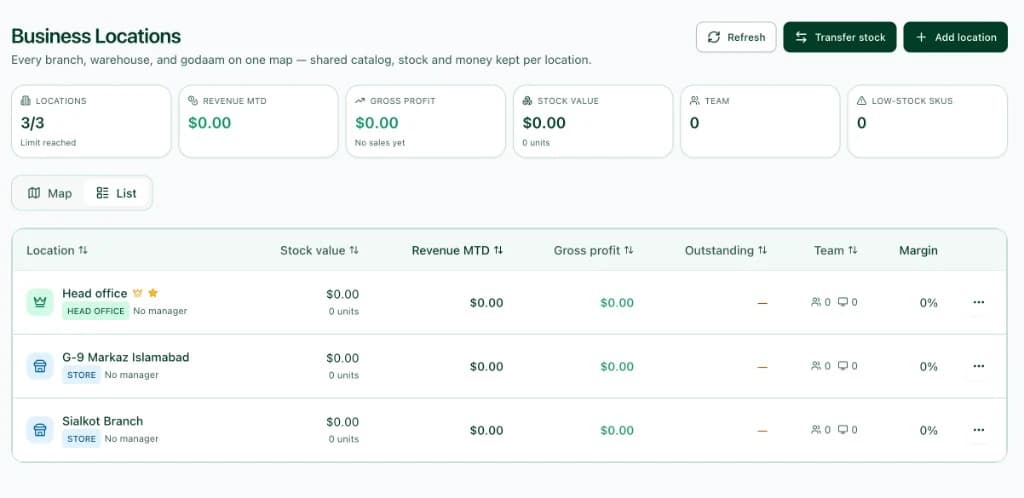
With Tejarify: Books, catalog, locations, stock, POS, transfers and staff live in one company account. Command Center is the view.
4. International products drain the bank; support does not get this economy
You should not pay USD retainers to people who have never closed a shop in this market.
Global suites bring quarter-long onboarding, licences that ignore PKR, and support queues that treat cash, khata, load, and how branches actually work here as afterthoughts.
What it costs you: Implementation invoices that outrun the benefit. Silence when the issue is “Karachi warehouse and Islamabad counter don’t share a catalog.”
With Tejarify: Built for how retail and distribution run here. Per-branch PKR. Support that already knows the issue is the chain.