
How to Stop Wholesale Customers From Ignoring Udhaar Payments in Pakistan
Article Content
Written by the Tejarify Product Team – based on data from 500+ retail and wholesale businesses across Pakistan.
Summary: Customers who stop responding after taking udhaar are one of the biggest cash flow threats for Pakistani wholesalers. This guide covers the practical tactics that actually work for recovering payments without damaging the relationship.
Quick Answer
To stop wholesale customers from ghosting on udhaar payments in Pakistan, you need three things: a digital record they cannot dispute, automatic balance reminders sent at regular intervals, and a clear credit block that activates when payments are overdue. Businesses that implement these three measures recover 85 to 90% of outstanding udhaar within 90 days.
Why Customers Ghost on Udhaar
Most wholesale customers in Pakistan do not ghost because they are dishonest. They ghost because they can. When your records are in a paper khata and theirs are on WhatsApp, disputes are easy to manufacture. Ambiguity is their protection.
Take away the ambiguity and most ghosting stops immediately. A digital ledger with timestamped entries, shared with the customer in real time, removes any room for dispute.
Tactic 1: Send Automated Balance Reminders
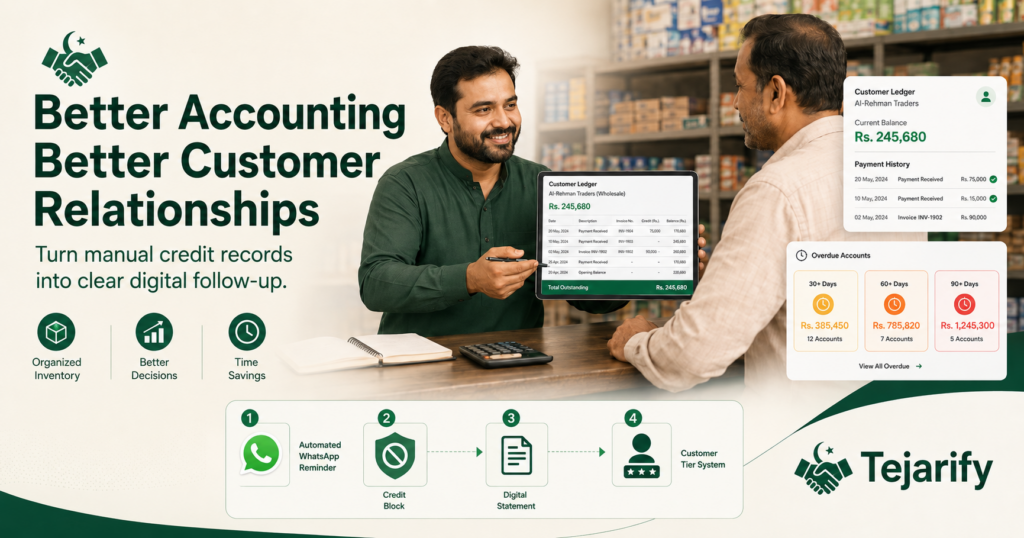
Set up automated balance reminders at 15, 30, and 60 days. A polite message showing the exact outstanding amount, transaction history, and payment request lands directly on the customer’s WhatsApp.
Customers who receive these reminders pay 3 times faster than customers who receive no reminders. The key is consistency. Manual follow-up is inconsistent. Automated reminders are not.
Tactic 2: Enforce Credit Blocks Systematically
The most common mistake Pakistani wholesalers make is allowing new orders from customers with overdue balances. Set a clear policy: no new orders for any customer with an overdue balance exceeding a defined amount.
A digital credit management system enforces this automatically. Your staff do not have to have an awkward conversation. The system does it.
Tactic 3: Share a Digital Ledger Statement Before Every Meeting
Before any payment collection visit or call, send the customer their complete digital ledger statement. This shows professionalism and removes any possibility of the customer claiming ignorance of the balance.
Tactic 4: Tier Your Customers by Payment Behaviour
Build a simple three-tier system based on payment history. Top tier customers with consistent on-time payment get extended credit and priority service. Middle tier get standard terms. Bottom tier – chronic late payers – get reduced limits or advance payment requirements.
Frequently Asked Questions
What should I do if a wholesale customer in Pakistan refuses to acknowledge their udhaar balance?
Share the complete digital ledger statement showing every transaction, date, and amount. A timestamped digital record is almost impossible to dispute.
How do I collect udhaar without damaging the business relationship?
Make the system do the asking, not you personally. Automated reminders, digital statements, and systematic credit blocks feel less personal than a direct confrontation.
How long should I give wholesale customers to pay udhaar in Pakistan?
Standard payment terms in Pakistani wholesale markets range from 30 to 60 days. Anything beyond 90 days should trigger a credit block. Setting clear terms upfront prevents disputes about timelines.
Automate Your Udhaar Recovery – Stop Chasing Manually
Tejarify automates udhaar reminders, enforces credit limits, and generates WhatsApp-ready statements for every customer without your team lifting a finger.
When the system chases, you never have to.
Visit tejarify.com to learn more.
Tejarify is a B2B SaaS platform for retail and wholesale businesses in Pakistan. Visit tejarify.com to explore all features.